Parallel Synthesizer
Reactor Configuration:
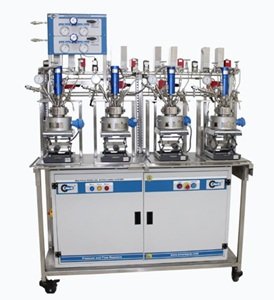
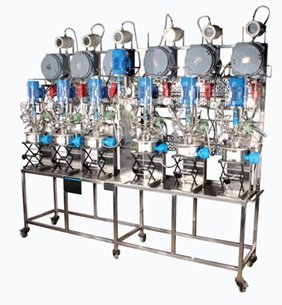
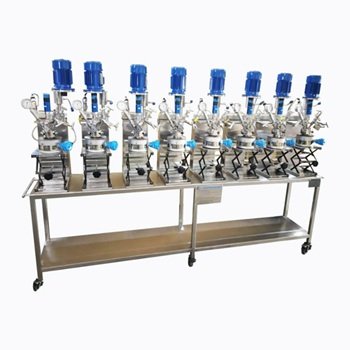
Combination of 4 or 6 reactors in parallel of either same or optionally different specifications
Volume: 100 ml to 2 L (for each reactor)
Pressure: Up to 350 bar (for each reactor)
Temperature: Up to 500 °C (for each reactor)
Material: SS-316, Hastelloy, Inconel, Monel, Nickel, Titanium, Zirconium, & Tantalum lined
Certifications: ASME-U Stamp / PED certified reactors, CE / CSA, Ex-proof / ATEX certified systems
Automation: High-resolution programmable 10" touchscreen panel with SCADA software for data logging & wireless remote control
Auto-Cooling System: High-pressure water-based auto-cooling system for excellent temperature control & quick cooling from high temperatures
Head Mounting Options: Removable or fixed head with pneumatic / hydraulic raising, lowering, & tilting
Stirrer Options: Pitch blade turbine impeller, high mass transfer gas induction impeller, anchor & helix for various applications
Customization: Volume, temperature, pressure, and design customization available on request
Applications:
Alkylation, Amination, Bromination, Carboxylation, Catalytic Reduction, Chemical Synthesis, Chlorination, Dehydrogenation, Esterification, Ethoxylation, Halogenation, Hydrogenation, Material Synthesis, Methylation, Nitration, Oxidation, Ozonization, Polymerization, Sulphonation, etc.
Description:
Parallel synthesizers are the next step in scale-up from our React-7 models, allowing larger quantities of typically liquid-phase reactions to be handled in parallel. Top-mounted stirrers enable safe operation under viscous, high-temperature, and high-pressure conditions, even with corrosive reagents, thanks to a wide variety of material options.
These reactors are the ideal choice for experimental design (DoE) programs aimed at optimizing synthesis conditions or screening catalysts. Independent gas pressure control is available for each reactor. Both jacketed and coil-based heating/cooling systems are supported, along with automatic data logging and PID control.
Process development teams frequently use these systems to close material balance models and to evaluate changes in heat and mass transfer when scaling from milliliters to liters.